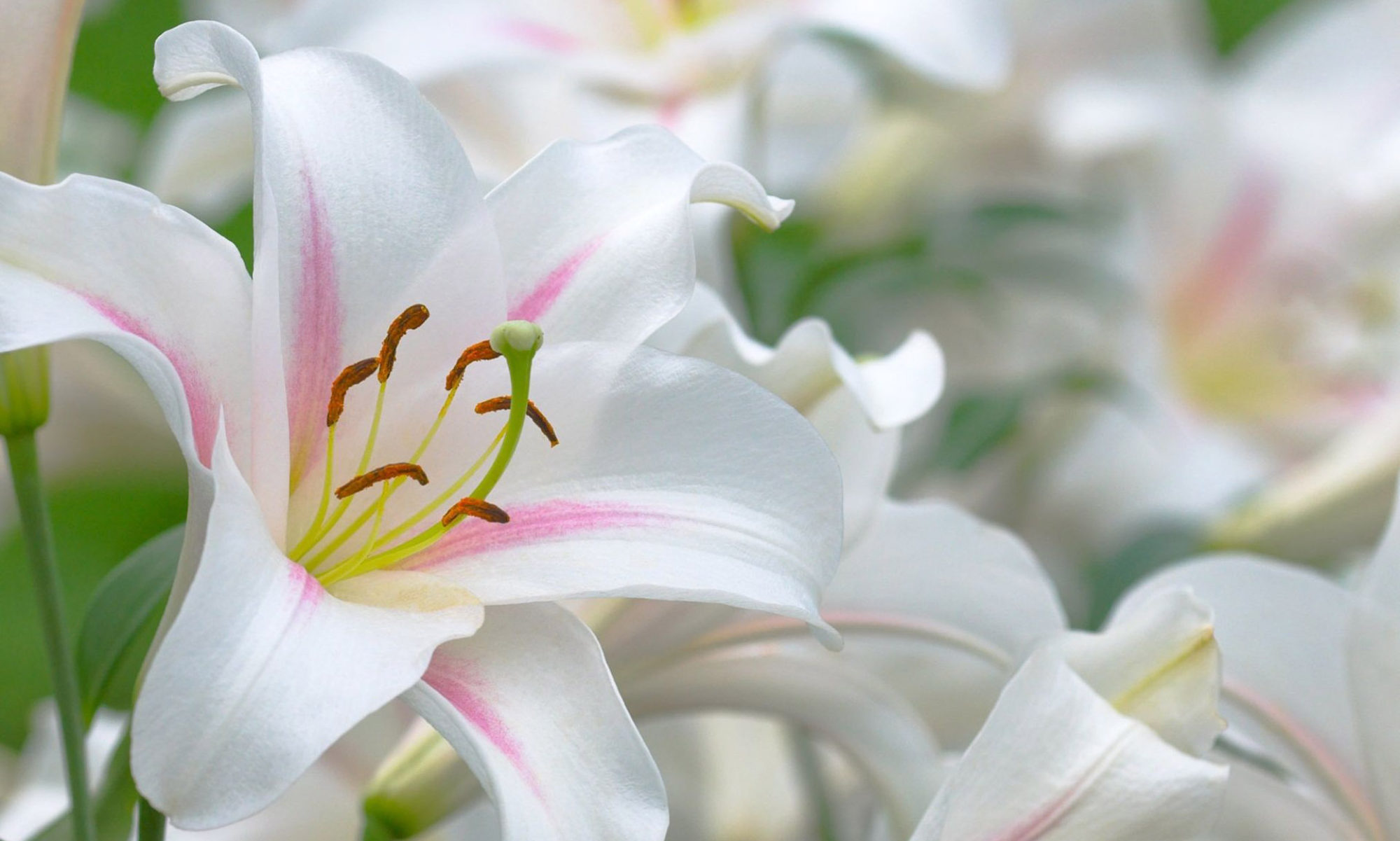
Every fall, I’m pleasantly surprised to find that some of the loveliest silver hues come late in the gardening season. Perhaps it’s the colder temperatures or the way autumn’s softer light is reflected on the leaves that brings out the intense color. Maybe it’s simply because there is little left in the garden to draw my attention, but I’ve found that silver foliage plants are definitely more striking in November than they are in July.
The featured photo above is Snow-in-Summer or Cerastium tomentosum, an old-fashioned perennial that is covered with enchanting pure white flowers in May. After blooming, the finely textured silver foliage remains a lovely focal point in the garden although these plants prefer and look best in cooler temperatures.
‘Sweet Romance’ Lavender is a workhorse in the sunny summer garden producing abundant wands of fragrant deep purple blooms over a long season while also attracting many pollinators. Although ever so pleasing to us, the deliciously sweet scent of Lavender repels deer and rabbits.
‘Berggarten’ Sage makes an eye-catching addition to the herb or flower garden with its bold yet softly textured leaves. Not only is this plant extremely showy but it also makes an excellent sage for use in the kitchen!
Japanese Painted Ferns incorporate a tapestry of colors on each and every frond while retaining an overall striking silver sheen.
‘White Nancy’ Lamium is one of my favorites for filling in garden gaps as this plant loves to politely ramble and spread amongst its neighbors without overpowering them.
Lamb’s Ears or Stachys byzantina should be included in every garden for its softly textured leaves that just beg to be touched! A classic grown with roses in the June garden, Lamb’s Ears also looks stunning next to white or blue flowers which are remarkably enhanced by its pleasing silver coloration.
Cobweb Hens and Chicks or Sempervivum arachnoideum is a remarkably hardy succulent that loves to tuck itself along and in between rocks or pavers. Colorful early summer blooms on long arching stems look like something from an alien planet but it’s the unusual cobwebby rosettes that make this plant special year round. An easy and fun plant for children to grow!
‘Excalibur’ Pulmonaria or Lungwort is an early spring charmer with pink to blue, forget-me-not style flowers. Long after blooming, the elegant lance-shaped leaves hold their striking silver color well into late fall!
Fall is prime gardening time so take advantage of these golden days to beautify your space, tackle some outdoor chores and get a head start on next year!
REFRESH SUMMER FLOWER POTS that are looking tired. Gently pull out any spent plants and replace with fresh annuals or perennials. Some cold tolerant varieties include Lamium, Pansies, Violas, Asters, Heucheras, Grasses, Ornamental Kale and Cabbages, as well as classic Chrysanthemums.
BRING IN ANY TENDER PLANTS you intend to keep over the winter. Summer houseplant vacation time is over, so make sure you bring your babies back inside now before evening temperatures start dipping into the 30’s. If you intend to save corms or tubers such as Caladiums, Cannas, Gladiolas or Dahlias, make preparations to store them properly over the winter so that you can enjoy them again next year.
CLEAN UP YOUR FLOWER BEDS by pulling up dying annuals and cutting back any dry and withered perennial leaves or flower stalks. Be sure to leave some seedheads for the birds and winter interest! It’s surprising how some minimal tidying up in the garden right now will refresh and revitalize the space and carry it through until that final killing frost.
LIFT, DIVIDE AND TRANSPLANT any overgrown perennials or add a few new ones. The moderate temperatures and reliable rainfall of autumn help plants get quickly established before winter sets in, giving perennials a vigorous head start on growth next year!
Photo courtesy of morningchores.com
PLANT FLOWER BULBS now for early spring color. The list of bulbs available for fall planting is vast so narrow it down to your favorites while also keeping bulb-snacking critters in mind. Some dependable bulbs that naturally repel voles, mice, chipmunks and squirrels include Snowdrops, Siberian Squill, Snow Glories, Hyacinth, Daffodils and Alliums.
SPREAD COMPOST around your plants to nourish and protect both new and established gardens. Adding nutrient-rich compost will greatly improve the quality of your soil and help retain moisture during dry summers. Good quality bagged compost is available at any garden center or start your own pile now: https://www.epa.gov/recycle/composting
CELEBRATE THE SEASON and be sure to give thanks for another bountiful gardening year!
All photos by Nancy Marie Allen except where noted
With fall planting season just around the corner, late August is the perfect time for evaluating our flower gardens and planning for any changes we’d like to see next season.
Start by taking a good look at your garden space(s), preferably with a notebook in hand, and jot down what you liked about this year and what needs changing. Ask yourself a few questions: What were your best performers this year and would you like to add more? Is it time to divide some overgrown perennials? Would you like to attract more birds, butterflies and bees? Do you need to focus more on xeriscaping with plants that require minimal water? And, what about adding some spring bulbs to extend your garden season with early color? Defining your garden goals and writing them down provides a convenient checklist to work from.
Now is also a good time to think about garden color, whether you grow perennials, annuals, or a combination of both. Do you love bright pops of red, orange and yellow or is a soothing pastel palette more your style? If you’re like me, you may want to use all of these colors over the season. For example, my earliest spring flowers and those that bloom through June tend to be pale yellows, pinks, purples and blues, while July through September blooms lean towards bolder and warmer colors.
When cool and warm colors are used together, they can really enhance one another such as the blue hardy geranium with golden Rudbeckia in the photo above. I also like to use white as it adds softness and elegance to any color scheme. Looking at a color wheel for reference will help you easily find colors that work together, whether analagous and side by side in the same color family or complementary at opposite ends.
As you dream about next year’s colorful flowers, don’t forget the importance of having good garden soil. Try to get into the habit of adding compost to your garden every fall for its valuable nutrients and moisture-retentive qualities. You can just layer it on top of your garden, around existing plants, and let the rain and snow of winter do the rest of the work. In the spring, add a generous layer of shredded bark mulch. Trust me, if you do these two things every year, it will make the difference between a garden that’s just surviving and one that’s thriving!
Successful gardening requires devotion and commitment, but even with all that enthusiasm, it’s easy to become overwhelmed by the sheer work involved in dividing and moving plants, improving soil, creating new flower beds or restoring old ones. However, by writing your goals down and prioritizing what’s most important, you can tackle one task at a time over months or even years, eventually ending up with the beautiful garden you’ve always wanted!
When we think about drought-tolerant plants, shade perennials rarely come to mind. In fact, we tend to think of shade plants as being especially reliant on water since many are native to moist woodlands, but although these plants certainly appreciate regular rainfall, they can survive long periods without it.
Typically, the well-watered areas where these plants thrive in spring become exceedingly dry by late summer. To make matters worse, where plants grow under the shade of large trees or shrubs, light rain showers are unable to penetrate the canopy of leaves, making some shaded areas the driest in our gardens.
Despite these harsh growing conditions, many shade perennials cope with hot and dry summers as well as their sun-loving cousins, so let’s take a closer look at a few of these remarkable plants and learn how we can help them beat the heat!
Hosta ‘Dancing Queen’ is a chartreuse beauty that holds up well in dry conditions (Photo by Nancy Marie Allen)
HOSTA
Hostas, also known as Plaintain Lilies, are stunningly beautiful foliage plants with broad leaves in varying shades of green, blue and gold, as well as many with contrasting borders and other variegations. Because of their bold appearance, they make excellent landscape plants for large areas, but what makes hostas really stand out amongst other shade plants is that they bloom abundantly in summer!
Hosta ‘Aphrodite’ (Photo courtesy of Thirkettle Nurseries)
Hosta flowers are as different in size and appearance as the plants themselves! Some gardeners cut the flower stalks off, preferring their hostas purely as foliage plants, but many hosta flowers are quite beautiful and even fragrant, and the bloom season stretches over the summer months into early fall. With enough different hostas, you can potentially have blooms all season long.
Hosta Lancifolia (Photo by Nancy Marie Allen)
The hosta known as August Lily blooms in late summer with large white flowers that are both striking and sweetly fragrant. One such variety is ‘Aphrodite’ which is just another plain green-leaved hosta until those flowers emerge, turning it into a ‘scentsational’ exotic beauty. If you’re considering this variety, be sure to plant it where you can appreciate its perfume whenever you pass by.
One of my favorites, old-fashioned Hosta Lancifolia is another fragrant late summer bloomer with abundant lavender bell flowers of delicate appearance. One in full bloom is a sight to behold!
Brunnera in Spring (Photo by Nancy Marie Allen)
BRUNNERA
Brunnera, Siberian Bugloss or False Forget-Me-Not is one of the most useful plants for lighting up dark shade. It blooms with tiny blue flowers reminiscent of Forget-Me-Nots in early spring but it’s the striking silvery foliage that makes this plant a season-long stunner.
Brunnera ‘Jack Frost’ (Photo by Nancy Marie Allen)
Brunnera is enchanting with tulips and late-season daffodils in the spring and makes a stellar companion for other shade plants which are only enhanced by its glowing leaves. In the photo above, you can see how Brunnera combines beautifully with a Blue Angel hosta and variegated Solomon’s Seal.
By late summer, when there is little flowering in the shade garden, silver and gold-foliaged plants such as Brunnera add glamor and much-needed contrast to what can be a sea of green. Light Up Your Garden with Silver and Gold Foliage has more about using these plants in your garden design.
Over time, Brunnera can spread to fill vacant spaces which also makes it valuable as a groundcover. Some popular varieties include ‘Jack Frost,’ ‘Silver Charm,’ and ‘Diane’s Gold.’
Solomon’s Seal in the shade garden (Photo by Nancy Marie Allen)
SOLOMON’S SEAL
Polygonatum or Solomon’s Seal is an extremely versatile plant that every gardener should get to know. With arching stems reaching two to three feet, this tall beauty makes a strong architectural statement whether used as a companion plant in garden beds or planted by itself en mass as a groundcover.
In spring, Solomon’s Seal is covered with tiny white bell-shaped flowers on the underside of the stems which are sometimes followed by small dark berries that are a treat for birds. The foliage remains fresh looking all season long, and is especially striking with white variegation. Polygonatum odoratum ‘Variegatum’ is one such variety with the added bonus of fragrance.
Solomon’s Seal in full sun with Asters and Lamb’s Ears (Photo by Nancy Marie Allen)
Although Solomon’s Seal is typically used in shade gardens, it can also be grown in full sun as a vertical accent. In addition, these plants turn a lovely shade of gold come fall, providing us with three seasons of interest to enjoy.
Ajuga ‘Chocolate Chip’ (Photo by Nancy Marie Allen)
AJUGA
Ajuga, also known as carpetweed or bugleweed, is one of the best mat-forming groundcovers for sun and shade gardens alike. A vigorous spreader via stolons or horizontal roots, ajuga quickly forms colonies of close-packed rosettes, making it nearly impervious to weeds. Here in New England, escaped plants from long ago often appear in lawns and are only noticed because of their lovely blue or white flower spikes in May.
Although ajuga will grow in full shade, half a day of sun intensifies the colorful foliage, especially in those varieties with purple shading. The spring flowers are quite showy but not very long-lasting, so ajuga is best planted for its eye-catching foliage which stays colorful through fall.
Ajuga ‘Black Scallop’ (Photo by Nancy Marie Allen)
Ajuga grows well just about anywhere including dry shade under trees, on slopes, in containers and between stepping stones. Some newer varieties to try are ‘Chocolate Chip,’ ‘Burgundy Glow’ and ‘Black Scallop,’ all with stunning blue flowers in spring.
Hay-scented Fern (Photo by Nancy Marie Allen)
FERNS
Ferns add elegance and airy movement to any garden and, since they’re non-flowering, it’s all about those graceful, and sometimes colorful, fronds. Although ferns in general tend to be moisture lovers, our native Lady Fern, Eastern Wood Fern and Hayscented Fern tolerate hot and dry conditions better than most. In the photo above, Hay-scented Ferns grows in full sun!
Additionally, I’ve found that Japanese Painted Ferns hold up well through hot dry summers, especially when planted closely with companions that shade the soil and help hold in any moisture. These unusual ferns add striking color to any shade garden and I highly recommend giving them a try!
Japanese Painted Fern showing burgundy ribbed fronds (Photo by Nancy Marie Allen)
The key to success with keeping shade perennials happy through the dry summer months begins with planting. Always amend your soil with plenty of organic matter such as compost or leaf mold before you add any plants. In this way you’re mimicking their natural woodland habitats where leaves accumulate and slowly break down over years, continuously feeding and enriching the soil.
Keep in mind that most shade plants enjoy some morning sun with afternoon shade. Also, as I mentioned above, placing plants fairly close to one another helps shade the soil and retain valuable moisture. Once planting is completed, mulch your plants each spring with a layer of fine shredded bark.
By following these tips, you can be assured that your shade perennials will thank you with beauty and vigor for many years to come!
In Northeastern Massachusetts where I live and garden, we’re sadly experiencing a severe drought this summer. On a daily basis I check the extended 10 day weather forecast, searching for any showers or thunderstorms that may be heading our way, but every time rain is predicted it often fizzles out before reaching us. This lack of adequate rainfall, coupled with searing temperatures in the 80’s and 90’s, has created a harsh environment for our flower gardens.
Since drier summers and water restrictions have become the norm in many parts of the United States, it’s a good idea for flower gardeners to familiarize themselves with drought-tolerant perennials that will grow well in their particular hardiness zone – plants that can be counted on to perform reliably when the going gets tough!
If you’re thinking about adding sun perennials to your garden, planting in autumn is a great time to do it. Roots will benefit from more regular rainfall and plants will get a good headstart on growth for the following year. In this way, they’ll be more robust and better able to withstand whatever the dog days of summer throw at them!
Here are a few remarkably heat and drought-tolerant perennials you can plant in your garden this fall:
Echinacea and Friends (Photo by Nancy Marie Allen)
CONEFLOWERS
Modern varieties of Echinacea, also known as coneflowers, come in a rainbow of colors and heights so it’s easy to find one to fit any flower garden. The common Echinacea purpurea is a tall pink/purple native with dark golden centers that attact butterflies, beneficial wasps and bees. The large seed heads also provide nourishing food for birds come fall, so don’t be in a hurry to deadhead these beauties! Echinacea are prolific summer bloomers with some repeat bloom into early fall.
Yarrow ‘Pink Grapefruit’ (Photo by Nancy Marie Allen)
YARROW
Lacy-foliaged Yarrow is a native wildflower here but there are many modern cultivars now available in a variety of colors. These versatile plants have a long history of medicinal applications including use in the battlefield to staunch bleeding from wounds. In addition, yarrow is beneficial in the garden as it attracts a variety of pollinators and enriches the soil with nutrients making it a great addition to the compost pile. Yarrow grows well in poor soil and shrugs off the heat with ease; it’s also tolerant of both dry and wet conditions.
The older blooms of yarrow soften in color with age (Photo by Nancy Marie Allen)
Each yarrow bloom is actually made up of many tiny flowers clustered together. The color of each cluster changes through the season as older flowers fade and new ones emerge bright-colored. This creates a lovely effect of many color shades being present on one plant at the same time. Here in Zone 6, yarrow begins to bloom in June with repeat bloom throughout the summer.
Shasta Daisy ‘Becky’ (Photo by Nancy Marie Allen)
SHASTA DAISY
My favorite daisy is the cultivar known as ‘Becky’ whose pure white blooms with yellow centers bring classic cottage garden looks to any flower bed. Lovely with daylilies, catmint and roses, she also combines beautifully with native wildflowers.
Becky is one robust daisy with strong stems and a long bloom period that begins here in late June. She makes an excellent cut flower and regular deadheading will promote repeat blooming.
Rudbeckia ‘Goldsturm’ (Photo by Nancy Marie Allen)
RUDBECKIA
Black-eyed Susans are native to North America and are as common on windswept prairies as they are at the edge of woodlands. Dark centers contrast boldly with their golden yellow flower petals, so bright that the eye is instantly drawn to them! They provide a long season of bloom from summer to early fall and are beloved by pollinators and birds.
Perovskia or Russian Sage (Photo courtesy of Pixabay.com)
PEROVSKIA
Native to high elevations and harsh environments, rugged Russian Sage tolerates a wide range of growing conditions. Blooming in the garden at a time when many flowers are flat or disc-shaped, Perovskia sports long, graceful wands of powdery blue, adding a desirable element of airy movement while also providing cooling contrast to hot summer colors such as yellow, orange or red. If you prefer softer colors, a lovely and simple pastel vignette can be created using blue Russian Sage with pink and white Echinacea!
Perovskia atriplicifolia tends to be a large, sprawling plant that is best placed in the back of the flower garden. More compact varieties include ‘Denim n Lace’ and ‘Little Spire.’
Nepeta ‘Montrose White’ in early bloom (Photo by Nancy Marie Allen)
NEPETA
Nepeta or Catmint adds a softness to the garden with its gray-green foliage and blue, pink or white wands of flowers. Taller nepetas like ‘Six Hills Giant’ are great ‘filler’ plants for any open spaces and shorter varieties like ‘Little Titch’ make a lovely edging. The foliage of catmint is aromatic when brushed up against and repels aphids and Japanese beetles, thus making it a perfect companion for roses! Although most nepetas flower heavily in June, they repeat bloom over a long season.
‘Montrose White’ is a stunning summer blooming variety that will provide dainty sprays of cool white blooms through fall. An added bonus is that this catmint attracts honey bees and other pollinators like nothing else in the garden!
Of course, this is but a short plant list for there are many other heat and drought-tolerant perennials out there. Choose varieties and colors that appeal to you and fit into your garden space and look forward to enjoying their care-free beauty for many summers to come!
Many of today’s modern ferns are descendants of ancient plants that have lived on the earth for millions of years. This fact alone speaks of their hardy and resilient nature but although ferns are tough plants, they are also graceful, striking and surprisingly easy to care for!
A volunteer garden fern of unknown variety makes a home with Creeping Jenny
Just one large fern planted in an urn provides a focal point of instant elegance, but potted ferns can be combined with other plants as well. The newly planted fern above will fill out quickly and the bright Creeping Jenny will spill generously over the edge. This simple but dramatic combination will light up my entryway all season long and require only minimal care. You can also group several pots of ferns together to create a soothing, serene and tropical looking summer oasis. Urban yards which many times lack abundant sunlight are the perfect settings for potted ferns!
Close-up of Japanese Painted Fern with Black-eyed Susan
Although ferns are thought of as shade plants, some are remarkably sun tolerant. As a general rule in Zone 6, I like to place ferns where they get morning sun followed by afternoon shade to protect them during the hottest part of the day. If you live in warmer areas of the country, you’ll want to provide your ferns with more shade. The beauty of planting ferns in pots is that you can easily move them around to find their perfect happy place!
Japanese Painted Fern ‘Burgundy Lace’ showing some late spring color
The following colorful hardy ferns look fabulous in pots and are easy care for beginners and experienced gardeners alike:
Japanese Painted Fern
The popular Athyrium niponicum‘Pictum’ is variegated with graceful fronds of varying silver, purple and burgundy coloration. The variety ‘Burgundy Lace’ emerges as a striking purple-red in early spring, slowly changing to silvery green with deep red ribs. ‘Metallicum’ retains a cool silvery-gray metallic sheen and really lights up darker areas.
Autumn Fern
If you prefer a warmer palette, the Autumn Fern, Dryopteris erythrosora, emerges a bright orange-red or copper color in the spring, then slowly changes to a bright green. ‘Brilliance’ is a particularly striking variety with new fronds showing dazzling color throughout the season. This well-behaved fern is perfectly sized for growing in pots with companion plants but it does prefer more shade!
Hay Scented Fern
Dennstaedtia punctiloba, the common Hay Scented Fern, is so called because it emits a pleasant scent reminiscent of freshly mowed hay when crushed or disturbed. These bright chartreuse ferns change to a pleasing soft yellow in the cooler days of fall. Hay Scented Ferns can be aggressive spreaders in the garden but are easily contained in a large pot where one plant makes an eye-catching specimen. In spite of their delicate and lacy appearance, these ferns can tolerate more sun than others.
Hay Scented Fern
You can purchase ferns at any garden center but if you already grow ferns in your garden or know someone who does, mature clumps can easily be spaded up and divided in the spring to grow on in pots.
Ferns enjoy rich, humusy soil which retains moisture so you may want to add a little compost to your potting mixture. Water your potted ferns early in the morning so that any drops of moisture on the fronds dry off before the sun gets hot enough to cause sunburn. Ferns like to be kept evenly moist but not waterlogged. A little liquid kelp once a month should be all the fertilizer they require to look their best.
At the end of the growing season in October, ferns can be planted back into the garden, or the pots can be moved to an unheated garage or cellar for the winter months. This cold period will mimic their natural outdoor conditions. Give them a small drink of water about once a month while dormant indoors, just enough to keep them from completely drying out. Move the pots back outside once temperatures have warmed up in the spring and resume watering as usual. Potted ferns should grow well for about three years when they will need to be divided to start the process once again.
Here in New England, Forsythia shrubs herald the arrival of spring like nothing else in the landscape and April is their time to shine.
Forsythia is not native to the United States but originated in Asia and started to appear in Europe around the mid-1800’s with American hybrids coming along around the time of World War I. Also known as ‘Golden Bells,’ Forsythia was named after the Scottish botanist, William Forsyth (1737-1804), a founding member of the Royal Horticultural Society. (from A Brief History of Forsythia by Mary Ellen Hammond, March 2017)
Although Forsythia have become commonplace, that doesn’t make them any less glorious! Even on the grayest days, they are beacons of light in the landscape. You’ll find many older shrubs growing along roadsides and creeping into shady woods where the blooms may be sparse but still a treat to our winter-weary eyes.
Forsythia are sun-lovers, so for the showiest blooms give these beauties at least six hours of sunlight daily. Other than that, these hardy shrubs will grow in just about any soil and even tolerate dry conditions once they’ve matured. In addition, they don’t seem to be bothered by pests or disease, and even the voracious whitetail deer leave them alone!
Another plus with Forsythia is the wide range of sizes and shapes now available to the American gardener. Tall, spreading and arching types can quickly fill out into impressive specimens, reaching 8 to 10 feet in height and width at maturity. Left to grow wild on their own, sprawling hedges can form over time, for when the long arching branches eventually touch the ground, they take root and make another shrub. But don’t let the vigorous nature of these larger shrubs scare you off, for there are many petite or dwarf varieties which are perfect for the average-sized home garden.
A Forsythia blooming alone is indeed a beautiful thing but when planted with flowering companions, the effect can be enchanting. How wonderful that Forsythia bloom at the same time as cheerful daffodils and other bulbs! You’ll find that even a small shrub makes a big statement when underplanted with complementary bulbs and early blooming perennials.
One thing to note is that the color of Forsythia blooms can be anything from a soft primrose yellow to deep gold, depending on the variety, so consider these cool or warm hues when choosing flowering companion plants.
It can be helpful when shopping at your local plant nursery to group some shrubs or plants together with your choice of Forsythia to get a better idea of how the colors will look combined in your garden. If you already have a Forsythia, clip a flowering sprig to take along with you. That said, winning color combinations can be created with Azaleas, Cherries, Quince, Pieris and more. One of my personal favorite vignettes is Forsythia underplanted with the sparkling periwinkle blue flowers of Vinca!
Easy-care Forsythia grows best in USA Hardiness Zones 5 – 8 and makes the perfect shrub for beginning gardeners!
In many parts of the United States, we are deep into heating season and spending much of our time indoors. Whether we use oil, gas, electric or wood to stay warm, the heated air in our homes can become bone dry as winter wears on.
We humans acutely feel the loss of moisture in our skin, hair and mucous membranes as humidity levels drop, but don’t forget that our houseplants crave moisture as much as we do. So, how do we keep our plants (and ourselves) healthy and happy in this arid environment? The following are some simple and practical tips to help raise the humidity in our homes to a more comfortable level:
WATER PLANTS THOROUGHLY
The simple act of watering plants is the easiest way to put moisture back into the air of our homes, but just giving your plants a halfhearted passing splash is not going to do the trick. When watering, try to use the ‘drench and drain’ method. By this I mean to water a plant thoroughly, preferably in a sink or tub, where the water can generously run through the potting medium and out the drainage hole(s). Allow the pot to drain completely before returning the plant to its usual home. Alternatively, you can place your potted plant in a bowl of tepid water for an hour or so while it soaks up what it needs. Your houseplant’s pot will feel heavy with moisture after you do this and will keep your plant hydrated for a longer period of time. When the pot feels light again, it’s time to water thoroughly!
AIR DRY YOUR LAUNDRY
Whenever possible, hang laundry around your house or apartment to air dry rather than use a clothes dryer. The damp clothes will not only dry surprisingly fast indoors but will replace much-needed moisture in the rooms where they are placed. I like to utilize bathroom shower rods, towel racks and over-the-door clothes hangers for this purpose. Foldable clothes drying racks are also easy to store and convenient for indoor winter use!
UTILIZE BATHROOM STEAM
We Americans love to shower, so why not leave the bathroom door open while showering or bathing to allow that health-giving steam to escape and disperse into your living space. Many plants thrive in these typically humid rooms so, if space allows, you might move some plants into the bathroom for the winter months; just be sure there is adequate light from a window or LED fixture.
TAKE ADVANTAGE OF WARMER DAYS TO OPEN UP
Baby, it’s cold outside! But not all winter days are dry and frigid. On cloudy or rainy days, when outside temps are above freezing, try cracking open a window or two to circulate the air for a little while. Be sure to move any plants away from the windows so that the colder air won’t be blowing directly on them. The natural humidity and fresh air will not only help your home feel instantly more comfortable, it will also cheer your winter-weary soul!
POLLY PUT THE KETTLE ON
Heating water in a kettle on a woodstove or kitchen range and letting the steam escape into the air works pretty much in the same way as a humidifier. Making stovetop winter soups and stews helps, too! If you’re fortunate to have a bright kitchen windowsill, any plants placed there will also benefit from the extra moisture given off by daily washing and cooking.
HUMIDITY TRAYS AND HUMIDIFERS
Humidity trays are easily created using a flat baking sheet or even a single plant saucer. The idea is to use pebbles or flat stones to cover the tray or saucer bottom, add water to fill, and then place your plants atop the pebbles so that they don’t sit directly in the water. As the water in the tray or saucer slowly evaporates, your plants will enjoy that extra moisture!
If your home is extremely and persistently dry, or if you suffer from allergies or respiratory issues, a good quality humidifier will certainly help. These are a great way to direct humidity where you need it most such as in bedrooms and nurseries or near tropical orchids, African violets, ferns and other moisture-loving plants. The downside is that humidifiers can quickly grow mold so be sure to keep your unit clean as per the manufacturer’s instructions.
For more on winter houseplant care, please check out my previous posts:
Have you ever noticed how accents of silver and gold really add sparkle to the holidays? By using these same colors in our gardens, we not only enhance the beauty of surrounding plants but substantially increase our overall botanical bling!
In my woodland garden, shown in the featured photo above, silver and gold perennials are used together to draw one’s attention to this shady spot. Although the garden would still look lovely with just green plants, it would lack the drama that these brighter plants impart.
Golden ‘Dancing Queen’ Hosta helps companion plants shine (Photo by Nancy Marie Allen)
Golden perennials and shrubs are all the rage right now and it’s easy to see why. These garden gems are useful in that the eye is immediately drawn to them and because of this phenomenon, they are especially effective in brightening darker, shady areas. Hostas, Creeping Jenny, Bugbane, Heuchera, Heucherella, Golden Oregano and Japanese Forest Grass are just a few gold foliage plants to use in shade to part sun.
Golden Hostas, Bugbane and Creeping Jenny make this shade garden glow (Photo by Nancy Marie Allen)
Gold in the sun garden can be absolutely dazzling in its brightness! Golden-striped ‘Color Guard’ Yucca is a particularly bold accent plant and one of the best for dry, sunny sites. ‘Aztec Gold’ or ‘Sunshine’ Veronica are excellent low-growing groundcovers for smaller gardens, while ‘Sun King’ Aralia, eventually growing 4 to 6 feet in height and width, should be given plenty of room to spread. Some Hostas such as ‘Golden Sculpture’, ‘Sum andSubstance’ or ‘Sun Power’ can also tolerate sun, although morning sun with some afternoon shade is always best for these beauties.
‘Color Guard’ Yucca (Photo by Nancy Marie Allen)
With a few exceptions, many gold foliage perennials tend to ‘burn’ with too much sun. You may notice the leaves blanching out (whitening) or the edges turning brown, especially in warmer climate zones. If you find this to be the case, just move your plant(s) to a little more shade until you find the perfect spot!
Silvery ‘Jack Frost’ Brunnera looks striking next to a Blue Angel Hosta (Photo by Nancy Marie Allen)
While far more subdued in appearance than gold, silver foliage plants also bring welcome light to the garden and blend well with both hot and cool colors. Some easy-care silver plants for shade include Brunnera, Lungwort, Lamium and Japanese Painted Fern. Even without flowers, their striking foliage patterns create visual interest all through the growing season!
Berggarten Sage (Photo by Nancy Marie Allen)
Sun lovers like Lambs Ears and Berggarten Sage become even more intensely silver in color as temperatures dip. An added bonus with these plants is their soft fuzzy texture that begs to be touched!
Summer blooming Rose Campion produces abundant cool white or hot pink flowers that contrast boldly with its silver-leafed stems, while Snow-in-Summer is an early spring bloomer with bright white flowers that nearly cover the ground-hugging tiny silver leaves. Other sun-loving silver plants include Russian Sage, Artemisia, Silver Thyme and Lavender.
Silver plants also tend to ‘glow’ at dusk and because of this make excellent additions to white flower or moon gardens!
Rose Campion is a classic silver foliage perennial (Photo by Nancy Marie Allen)
The well-known Burl Ives song includes the lyrics, “Everyone Wishes for Silver and Gold.” Instead of just wishing, I encourage you to add some of these sparkling plants to your garden next spring!
The dark months of November and December are a time for bringing some of nature’s greenery inside – whether with Christmas trees, fresh-cut garlands or classic holiday houseplants. While the striking flowers of Thanksgiving cactus, Amaryllis and Poinsettias will certainly make our homes feel festive, how about including some new, unusual and, perhaps unexpected, fall to winter bloomers this year?
Hoya ‘Odorata’ carries a lovely fragrance (Photo by Nancy Marie Allen)
HOYA
Hoyas are very easy to care for and reward the grower with exotic, almost otherworldly, waxy blooms which are pleasantly fragrant. Unlike other flowering plants, never deadhead the bloom stalks for they’ll repeat flowering over and over again from the same flower peduncles.
It’s fun to get creative with Hoyas since their vining habit makes them useful for climbing and twirling around a plant stand or cascading out of a hanging pot. Best of all, many Hoyas bloom with abandon through the fall and winter months. Hoya ‘Odorata’ is one such floriferous and sweetly-scented variety!
Aeschynanthus, also known as Lipstick or Basket Vine is a vigorous plant that blooms reliably through the darkest months and is extremely tolerant of dry, heated air. With its trailing habit and as its nickname implies, Basket Vine is perfect for a hanging basket where the long stems can gracefully spill over the sides.
The variety known as ‘Mona Lisa’ with its eye-catching vivid red tubular flowers and purple calyxes will brighten any room!
Red Anthurium (Photo by Nancy Marie Allen)
ANTHURIUM
Anthuriums are remarkable houseplants in that they tend to bloom all year! However, the ‘flowers’ are actually colorful heart-shaped spathes with a contrasting spadix which can remain on the plants for months. Regular deadheading of old blooms that have lost their vibrancy will keep new ones coming.
Although the more common red Anthuriums are the perfect complements to holiday décor, they also come in a vast array of other colors including pink, green, yellow, coral, white and purple. By collecting several varieties, you can enjoy a rainbow of colors year round!
Sweetly-scented Jasmine produces an abundance of blooms (Photo courtesy Pixabay)
JASMINE
If you’re a fragrance lover, then ‘scentsational’ Jasmine is a great choice for a sunny room; just be sure to look for those that are autumn to winter bloomers. Jasmines can be climbing, trailing or upright in habit so there’s plenty of versatility here as to where you place them in your home.
Sweetly-scented and everblooming ‘Orange Jasmine’ will easily fit on a small table or windowsill, while ‘French Perfume’ is a robust vining plant perfect for a stand, pot trellis or hanging basket.
Pink Abutilon (Photo courtesy Pixabay)
ABUTILON
Abutilons or Flowering Maples are typically grown as outdoor summer shrubs but there are several small-scale varieties that are well suited to indoor culture. The large, hibiscus-like flowers on these almost everblooming plants can bring a look of the tropics to our homes!
Abutilon ‘Blushing Belle’ is a romantic pink and white beauty that is compact in size and blooms nearly non-stop. ‘Miss Marmalade’ with its cheerful orange-yellow blossoms is a dwarf Abutilon that is ideal for a hanging planter. ‘Red Glory’ is a deep scarlet that makes a strong accent plant and is especially lovely when partnered with holiday greenery.